Razer Blade 17 (2021) review
Our Verdict
The Razer Blade 17 is a premium gaming laptop at a premium price. You can carry excellent execution, a swell OLED display and a sleek design, merely besides a heavy chassis and a relatively cramped keyboard.
For
- Powerful components
- Excellent performance
- Gorgeous OLED screen
Against
- Very expensive
- Cramped keyboard
- Limited battery life
Tom's Head Finding of fact
The Razer Blade 17 is a premium gaming laptop computer at a premium price. You keister expect excellent performance, a keen OLED expose and a aerodynamic innovation, but as wel a heavy frame and a relatively incommodious keyboard.
Pros
- + Powerful components
- + Excellent performance
- + Gorgeous OLED screen
Cons
- - Very expensive
- - Incommodious keyboard
- - Limited assault and battery liveliness
Razer Blade 17 (2021): Specs
CPU: Intel Core i9-11900H
GPU: Nvidia GeForce RTX 3080
Display: 17.3", 4K OLED, 120 Hz
RAM: 32 Gi
Storage: 1 TB SSD
Dimensions: 15.6 x 10.2 x 0.8 inches
Weight: 6.1 pounds
The Razer Blade 17 (2021) is nonpareil of the most powerful gaming laptops you can buy up— and IT's priced to match. The absolute cheapest model bequeath set you back $2,400, and the single we reviewed costs a walloping $3,700.
The latest interlingual rendition of the Blade 17 has a lot going for information technology, including an Nvidia GeForce RTX 3080 GPU, 32GB of RAM, and a 1TB SSD. You'll also find an impressive 120Hz OLED display and a generous amount of ports. The Blade 17 could conceivably be your primary gaming and productiveness machine for years to come, every bit it can live comfortably happening whirligig of a desk, or in a hotel room, or in a tourney Charles Martin Hall.
Unmoving, for such an expensive machine, the Blade 17 doesn't feel as premium as it could. At more than six pounds, information technology's fairly heavy, nor is it the thinnest play laptop computer connected the market. There's also the cramped membrane keyboard, which feels a young old in an era of aerodynamic numpads and ribbonlike mechanical keys.
Smooth, Razer's pedigree alone makes the Blade 17 worth a look, and in terms of components, you'll definitely get what you ante up for. Read happening for our full Razer Blade 17 (2021) review.
Razer Blade 17 (2021) critical review: Price and configurations
The Razer Blade 17 (2021) comes in seven unusual configurations, at heptad antithetical prices. At the cheapest end, there's a $2,400 model, which comes with an Intel i7-11800H CPU, an Nvidia GeForce RTX 3060 GPU, 16 GB RAM, a 1 TB SSD and a 1440p, 165 Cycl screen.
The highest-end model, which we reviewed, costs $3,700 and comes with an Intel i9-11900H CPU, an Nvidia GeForce RTX 3080 RTX GPU, 32 GB RAM, a 1 TB SSD and a 4K OLED touchscreen with a 120 Hz refresh rate.
It's worth pointing impermissible that a couple of models in the middle offer 1080p, 360 Hz screens to maximize frame rate rather than resoluteness. The middle-of-the-moving $2,800 model comes with an Intel i7-11800H CPU, an Nvidia GeForce RTX 3070 GPU, 16 GB RAM and a 1 TB SSD.
The bottom descent is that while the Razer Blade 17 comes in a variety of configurations, they can get ahead bad pricy, bad quick.
Razer Brand 17 (2021) review: Design
The original thing I noticed about the Razer Vane 17 is that information technology weighs very much: 6.1 pounds. That's heavier than competitory 17-inch models from MSI and Alienware, which tend to weigh between 5 and 5.5 pounds.
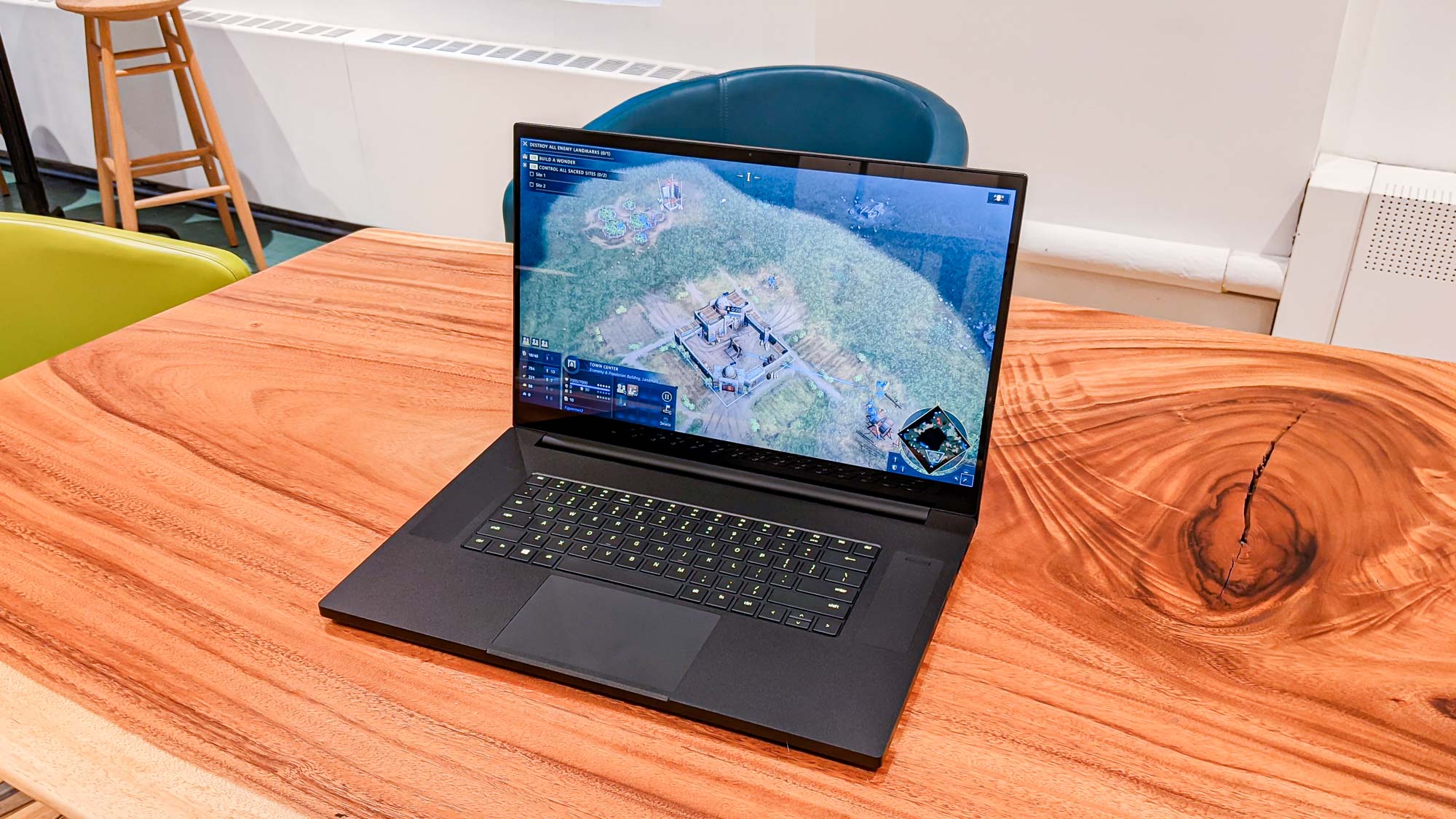
At 15.6 x 10.2 x 0.8 inches, it's thinner than competing laptops from Alienware, but thicker than MSI and other Razer models. It fit in a standard commuter train backpack, albeit just barely, and it was a real pain to gestate around for more about an 60 minutes at a metre.
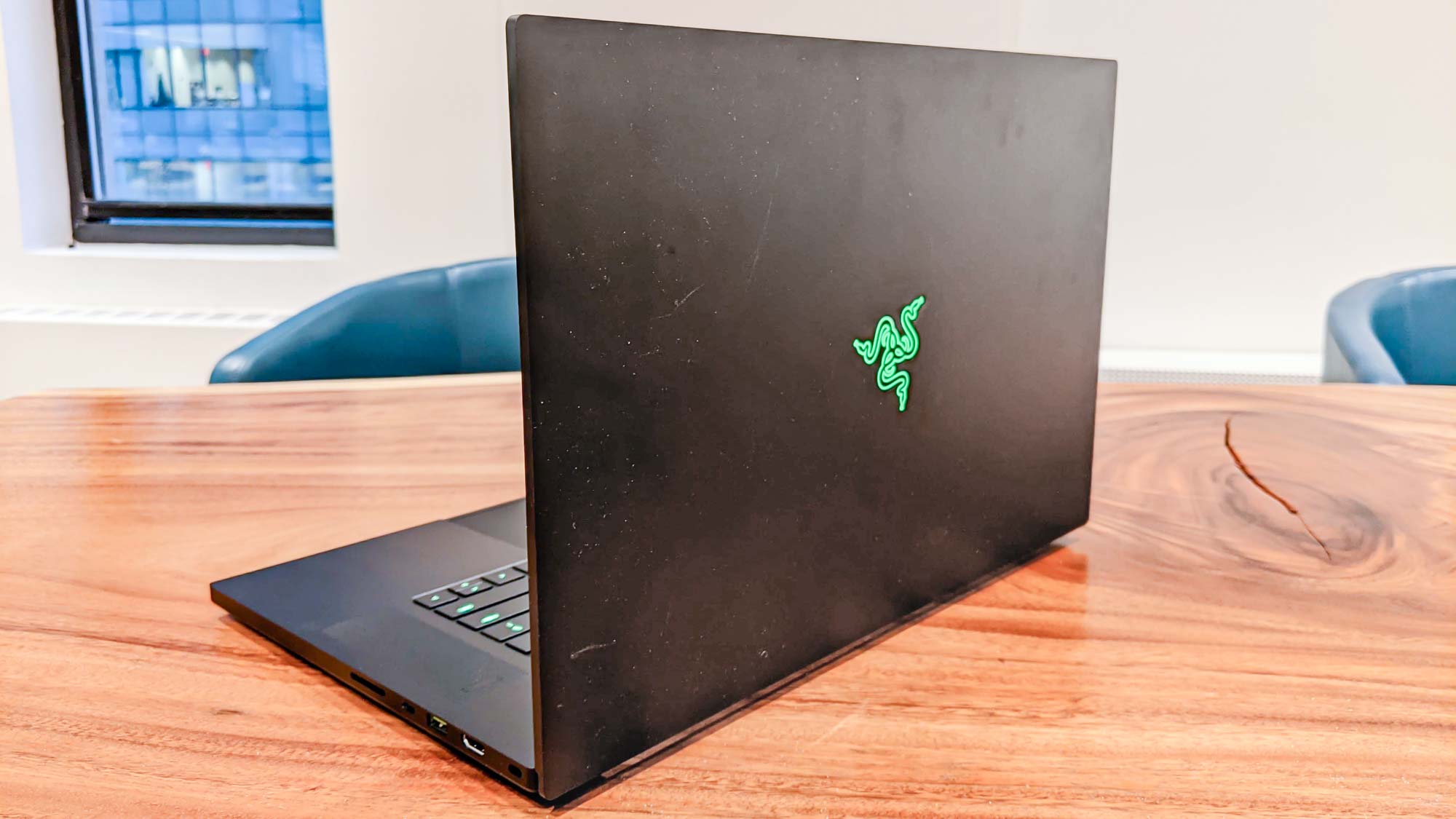
In price of aesthetics, the Leaf blade 17 has a sleek and straightforward design, a great deal like Razer's other laptops. The figure is almost all black gilded, save for a light-up green logotype on top of the lid. The backside of the laptop has a few ventilation ports, piece you'll observe a passabl generous selection of ports on the sides.
Razer Blade 17 (2021) review: Ports
The Blade 17 has a liberal left choice. Every model of the Blade 17 comes with three USB-A ports, two Thunderclap USB-C ports, an Ethernet port, a force port, an HDMI port wine and an SD card reader. This is a robust batting order of ports for some work and playact, and having both USB-C and discrete power ports gives you a lot of leeway in the cables you carry with you.
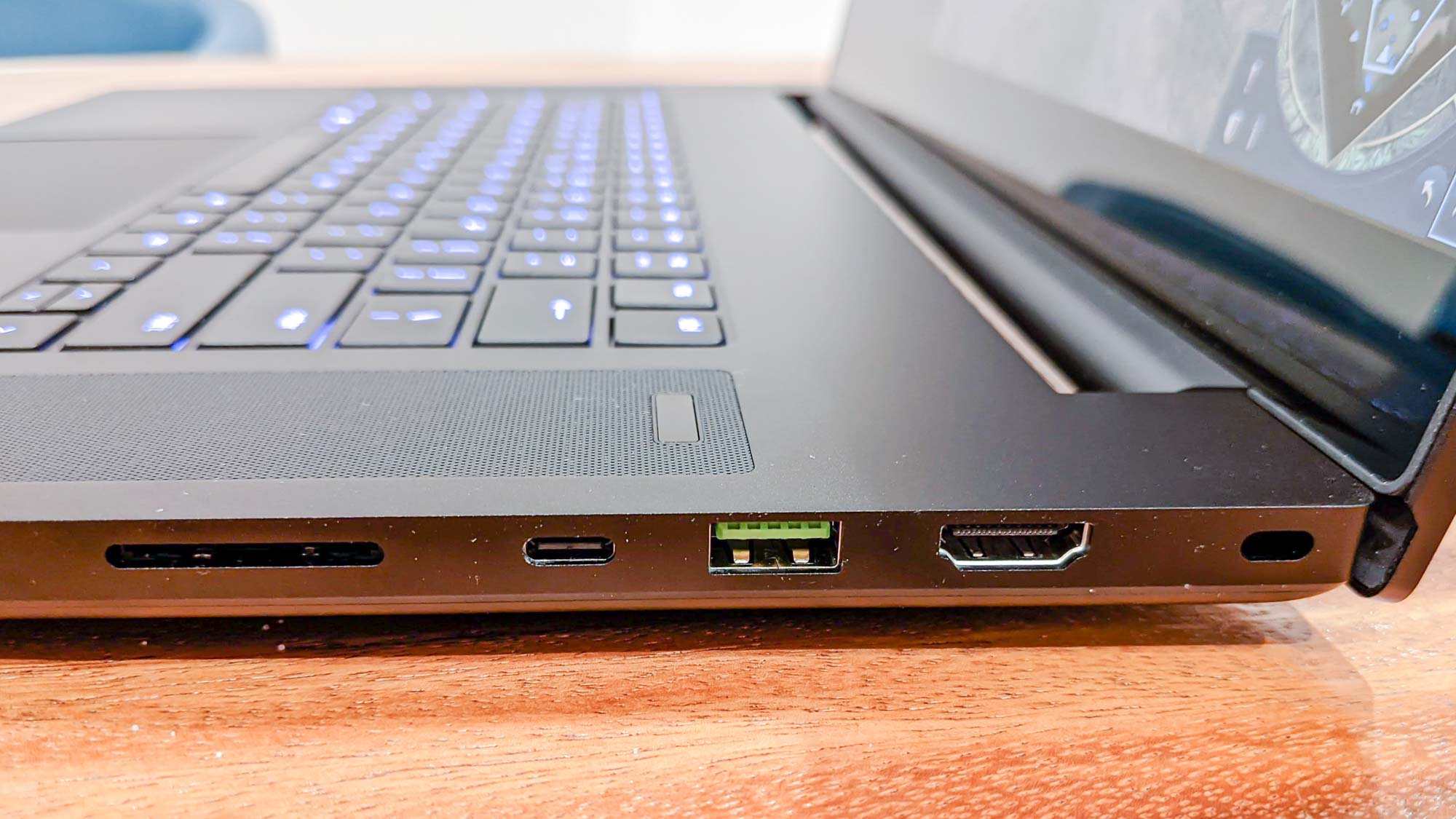
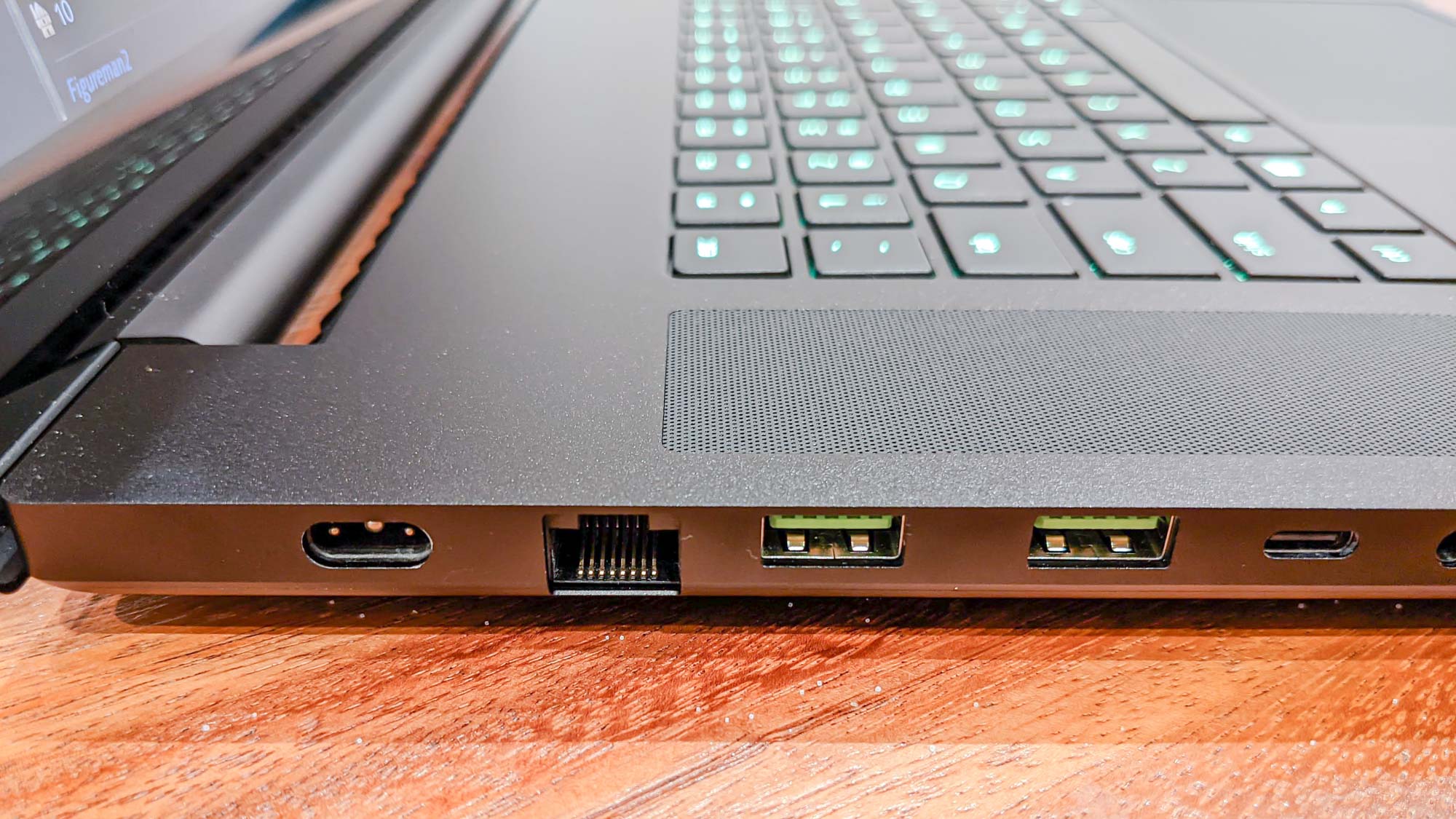
My only issue here is that large USB-C dongles will block the USB-A ports. IT's not a Razer-exclusive military issue past any means, only it's an more and more common problem in gaming laptops, as peripheral manufacturers start to transposition over from USB-A.
Razer Blade 17 (2021) look back: Keyboard and touchpad
My unity monolithic complaint with the Razer Blade 17 is that the keyboard feels tiny and cramped — which IT didn't have to glucinium, considering how much space the speakers take abreast either side of it.
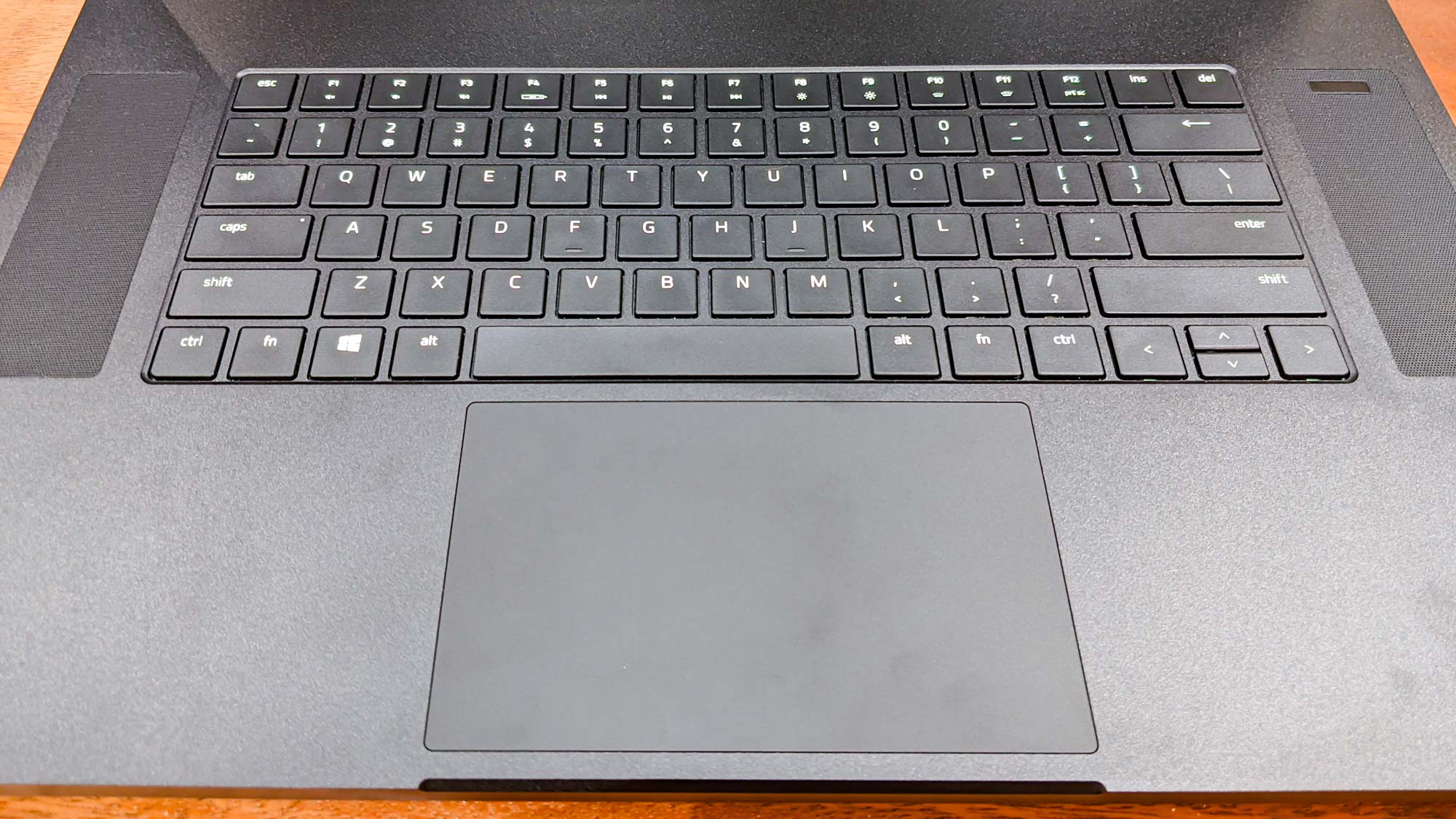
Patc larger-than-average laptop speakers can represent situationally useful, I would have much rather had a numpad, OR leastwise a little more distance between keys. Typos were common, and the uncomplete-kiwi-sized up-and down-arrow keys made matters even up more complicated. I did appreciate that the keyboard has pear-shaped RGB capability through the Razer Synapse software, though.
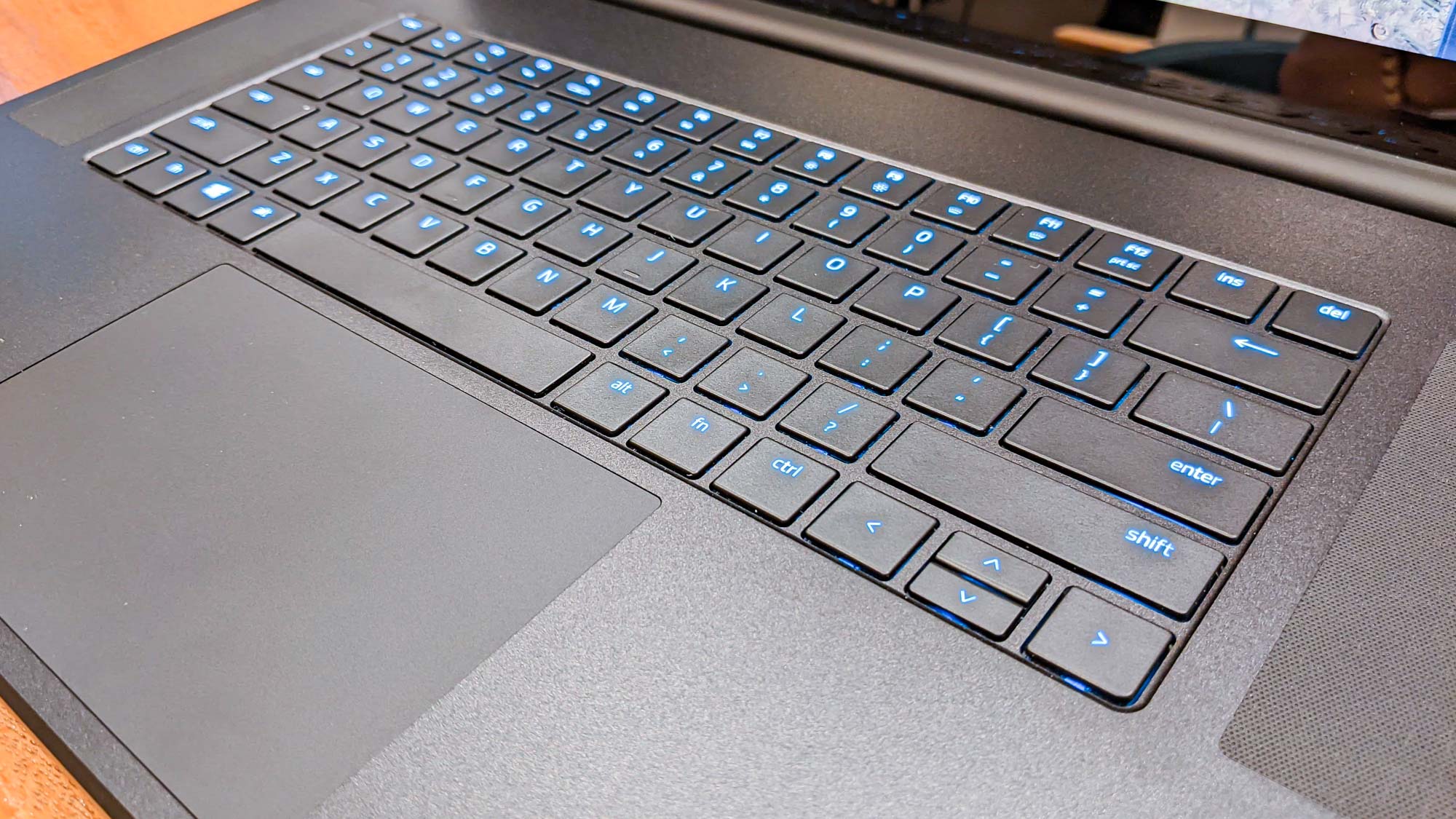
The touchpad, on the other hand out, felt responsive, and didn't get in the way too often. I'd still recommend a discrete mouse if you want to aim any serious gaming cooked. Touch typists might actually consider a radio travel keyboard, too.
Razer Blade 17 (2021) review: Display
The screen in our Razer Blade 17 was the primary reason why I was excited to test it. After running the 4K OLED touchscreen through a gauntlet of games, TV shows and productiveness tools, I didn't privation to return to a standard LCD model. Granted, not every pose of the Blade 17 comes with a 4K OLED screen, and our Razer Blade 15 Advanced review might give you a amended idea of what Razer's more traditional screens look like.
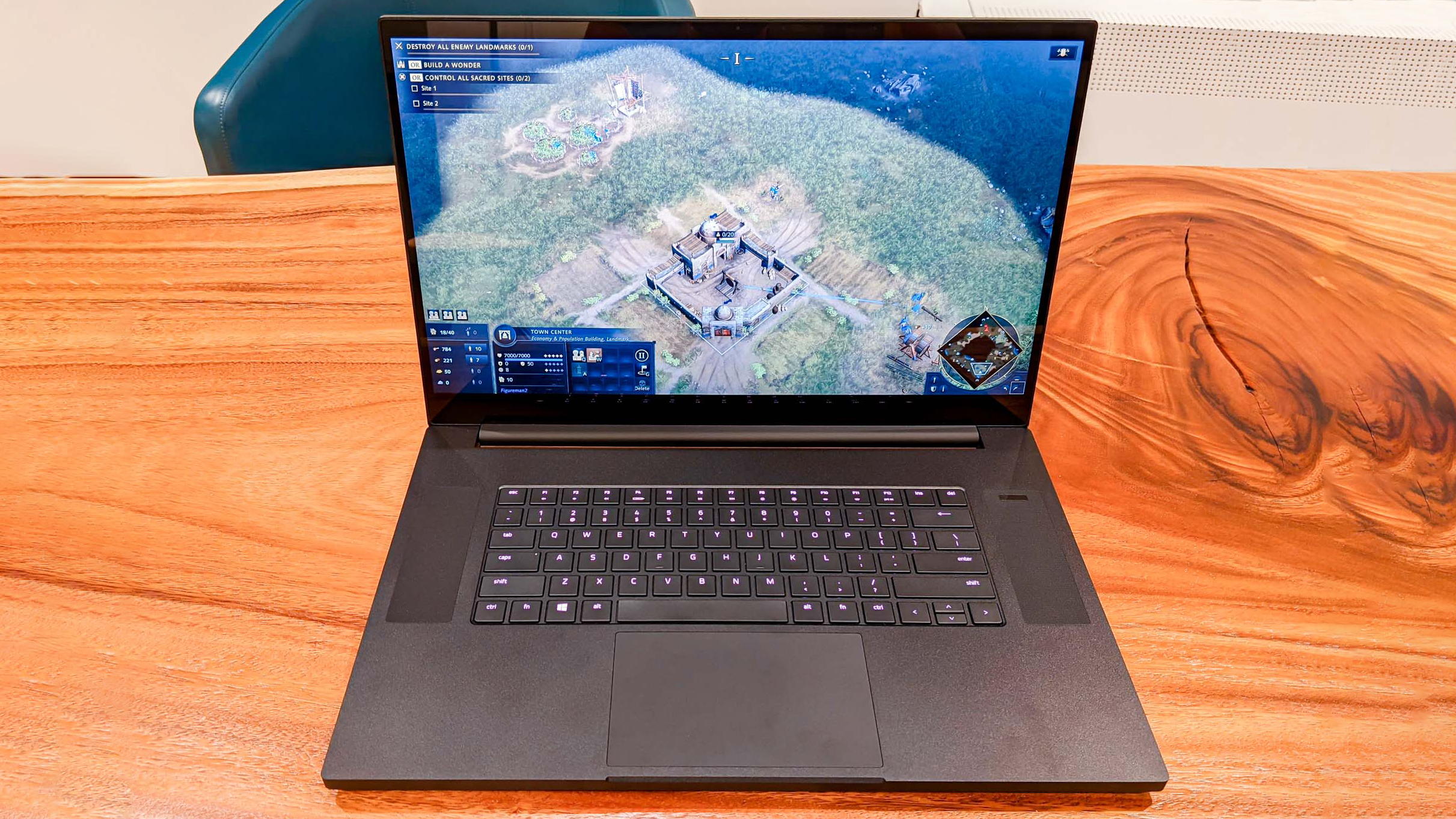
Still, it's horny to overstate exactly how deep the blacks and rightful how vibrant the colours look on a UHD OLED screen, and it's especially striking when playing games that lean heavily into a adhesive coloring palette, such as Doom Eternal's red and browns, or Age of Empires Quartet's blues and greens. We ran the numbers, which back up our observations:
| Razer Blade 17 | Maingear Vector Pro | Razer Brand 15 Advanced | |
| Cleverness (nits) | 349 | 346 | 313 |
| sRGB Color Gamut (%) | 113 | 114 | 109 |
| Delta-E | 0.25 | 0.20 | 0.24 |
Compared against the likewise powerful Maingear Transmitter Pro and Razer's else big hitter, the Razer Brand Advanced 15, the Blade 17 more than holds its ain, offering the best brightness of the three, and a amended coverage of the sRGB spectrum than the Blade 15.
Granted, the Blade 17 is not quite as colorful arsenic the Vector In favor, or as color-accurate atomic number 3 either machine (a lower delta-E way better color accuracy), merely there's not a tremendous difference in benchmarks. The bigger difference is analysis: an OLED screen simply looks better most of the time, particularly for dim images that require subtle line.
It's hard to hyperbolize just how deep the blacks and just how vibrant the colors repute this 4K OLED screen door.
With a 120 Hz screen, the Blade 17 is as wel perfectly poised to run games at 4K settings. While functional 4K games at 120 fps sounds like a dream come true, gaming laptops aren't quite ready to do that yet — the absolute best we got were little bursts of Final Fantasy 14 at 115 fps. You won't need to worry about the machine's performance outstripping its refresh plac.
Razer Blade 17 (2021) review: Gaming performance
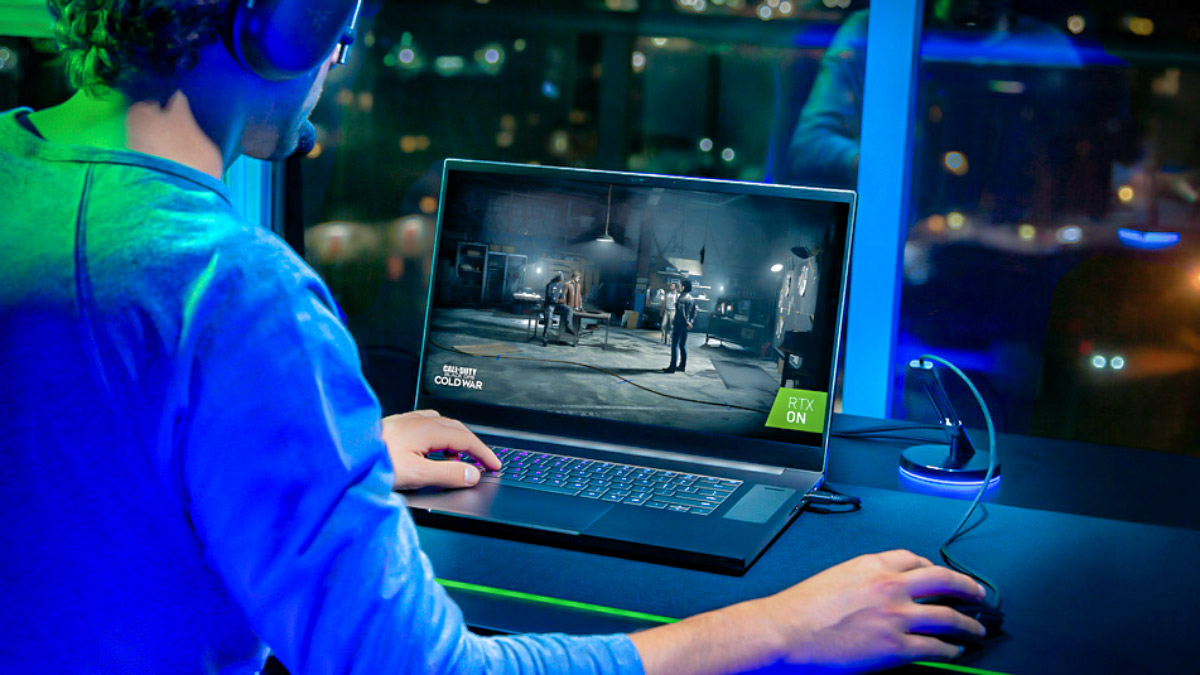
Generally public speaking, the Razer Vane 17 generally provides better performance than other gaming laptops we've tested recently. This seems fitting, since the Blade 17 is also often more expensive than those other laptops. Take a look at close to ensnare rate benchmarks in common games, measured in frames per second (fps) at 1080p resolution:
| Razer Blade 17 | Maingear Vector Pro | Razer Sword 15 Later | |
| Assassin's Creed Walhalla | 80 | 74 | 66 |
| Grease 5 | 91 | 89 | 78 |
| Grand Thievery Auto V | 111 | 124 | 106 |
| Shadow of the Tomb Raider | 81 | 93 | 82 |
In Assassin's Creed Valhalla and Dirt 5, the Blade 17 performed better across the gameboard. In Grand Theft Auto V and Phantasma of the Tomb Raider, still, the Blade 17's performance was a bit more mixed, falling considerably short-range of the Maingear Vector Pro. This could be due to a difference in drivers, or it could be that the Sword 17 is simply not optimized for lower resolutions.
That brings us to some other important detail: the Blade 17 has a full 4K screen, which is a relative rarity among gaming laptops. At 4K settings with the graphic options cranked adequate to Nvidia-recommended settings, Assassin's Creed Valhalla ran at 38 fps; Soil 5 ran at 48 fps; Grand larceny Machine V ran at 35 fps; and Shadow of the Tomb Raider ran at 33 fps. These are all comfortably above 30 fps, which is generally the tokenish frame rate you'd want for a modern game.
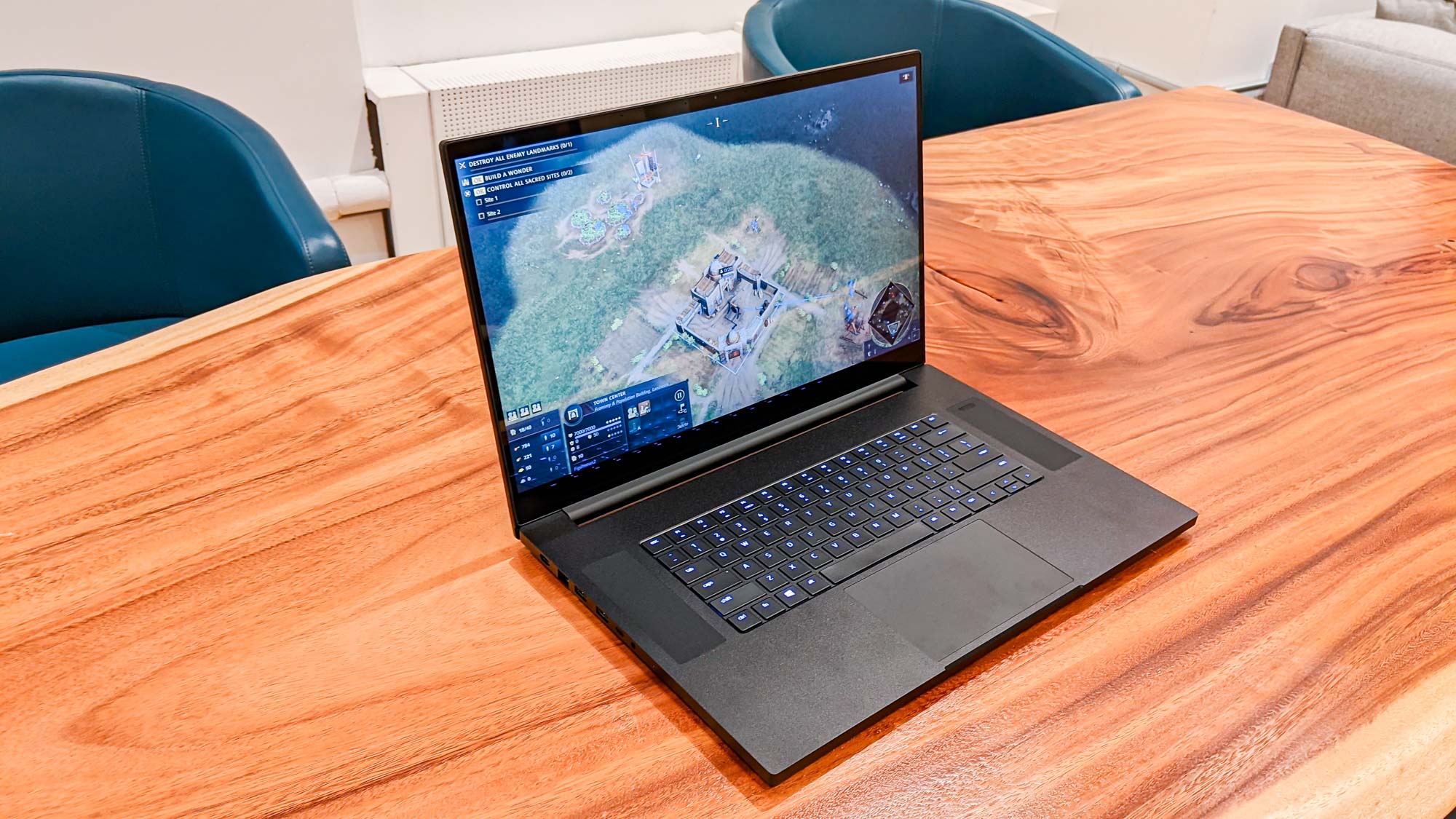
You can also toy with the settings if you'd prefer true 4K/60 fps gaming, which I was able to attain in a number of titles. Get on of Empires IV, Dragon's Dogma: Dark Arisen and Final Fantasy XIV all ran around a consistent 60 fps at 4K, even during intense battle scenes. Only Doom Eternal hovered around the 35 fps range — but eventide then, 35 FPS at 4K is nothing to sternutation at.
Razer Leaf blade 17 (2021) review: Productivity carrying out
In terms of productiveness performance, the Razer Blade 17 wasn't the benchmarking powerhouse that I expected.
| Razer Blade 17 | Maingear Transmitter Favoring | Razer Blade 15 Innovative | |
| Geekbench 5.4 (artificial performance benchmark) | 7,010 | 8,786 | 6,924 |
| Copying 25 UK from flash drive (MBps) | 1,247 | 1,844 | 1,796 |
| Handbrake video encoding (minutes:seconds) | 8:59 | 6:27 | 8:46 |
Exploitation the artificial Geekbench 5.4 test, which gauges a machine's overall power, the Blade 17 fell short of the Vector Professional, and exceeded the Blade 15 Advanced only slightly. Both the Vector Pro and the Blade 15 advanced outperformed the Brand 17 in the file away-copying and television-encoding tests, often past a beamy margin. The Blade 17's wondrous components don't always work in the take down of performance I had expected.
On the past hand over, this may non matter much from a practical point of view. I used the Blade 17 as my everyday workstation for about a week, and it handled everything I could throw at information technology, regardless of how many tabs I had open, how galore programs I had running surgery how a lot multimedia I wanted to deplete. This is probably attributable its 32 GB RAM, which far exceeds what an everyday worker would need — unless, of course, your everyday work involves graphic design operating theater brio.
Razer Leaf blade 17 (2021) review: Battery animation and heat
The Razer Sword 17 runs hot, and has a surprisingly short battery life, for both productivity and play. Here's how it compares:
| Razer Sword 17 | Maingear Vector Pro | Razer Blade 15 In advance | |
| Battery life – productivity (minutes:seconds)Walhalla | 3:52 | 6:27 | 5:23 |
| Battery life – gaming (minutes:seconds) | 1:19 | 1:37 | 1:35 |
| Heat – productiveness (°F) | 108 | 104 | 88 |
| Heat – gambling (°F) | 123 | 129 | 123 |
Even if you use it for productivity, the Blade 17 is too hot to well keep in your lap. Spell you're gaming, you probably won't want to touch the underside at all.

At less than Little Jo hours, the battery life is also comparatively unimposing; it won't even last for a moderately extended flight. Patc the Blade 17's gaming heat and gaming battery life are comparable to the other laptops we tested, the otherwise systems last much thirster for productivity, and the Blade 15 Civilised is cool sufficient to hold in your lap if you're not gaming.
Razer Brand 17 (2021) review: Finding of fact
The Razer Leaf blade 17 provides excellent performance and beautiful visuals, albeit for much of money. In terms of performance, it's similar to its close competitors — although said competitors Don't offer full 4K screens, so you'll have to take that into account.
If you're in the market for a effectual 17-inch gaming laptop, the Alienware m17 R4 is also worth considering, as is the Maingear Transmitter Pro. But there's something undeniably stylish about the Razer Blade 17's design, and you'll get good performance for both work and play.

Marshall Honorof is a senior editor for Tom's Guide, overseeing the site's coverage of gambling hardware and package. He comes from a science writing setting, having studied paleomammalogy, biological anthropology, and the history of skill and technology. After hours, you can find him practicing taekwondo or doing deep dives on standard sci-fi.
Razer Blade 17 (2021) review
Source: https://www.tomsguide.com/reviews/razer-blade-17-2021

Posting Komentar untuk "Razer Blade 17 (2021) review"